
BUDGET PILOT

Travel finance app designed to turn budget anxiety into effortless control — helping travelers plan, track, and stay within budget without breaking the flow of the trip.
CASE STUDY - 03
Mobile App · Personal Finance · Fintech for Travel
TYPE
SCOPE
End-to-end - Mobile · UX Research · Design System
ROLE
UX/UI Designer — Solo project
INDUSTRY
Travel Tech - Personal Finance
FOCUS
Expense Tracking - Intuitive Onboarding - Budget Control
DELIVERABLE
Hi-fi prototype - Design system


1. Empathize
Budget Pilot is designed for travelers who want to fully enjoy their trip without losing track of their finances — people who value simplicity, speed, and confidence over spreadsheets and complex budgeting tools.
Target audience:
Budget Pilot's identity is built to feel like a co-pilot, not a finance app — minimalist, agile, and visually calm, designed to manage money with intelligence and confidence without ever feeling technical or cold.
Branding definition:
Design of a mobile app to control a travel budget — allowing users to schedule a vacation period, log expenses in real time, and set alerts to stay within budget, all without interrupting the moment they're in.
The product:

To keep design decisions grounded in real needs, I built two personas — Bety and Ax — representing distinct emotional relationships with travel and money.
-
Bety, a 36-year-old virtual educator from Salvador, Brazil, travels frequently while saving for her future. Her core tension: she doesn't want to waste her trip manually adjusting accounts, and she wants immediate clarity on what she can spend without compromising her savings.
-
Ax, a nurse from Buenos Aires, finds emotional release in travel but experiences real anxiety around budgeting. Their main barrier isn't math — it's finding a tool that feels human rather than technical or cold.
User research:


To deepen my understanding of users, I created a Journey Map for Bety and Ax, about a user task for one of the app's core functions.
Journey map:
User Task: Use the BudgetPilot app to set the budget limit for a trip.
_edited.png)
To go deeper than personas alone, I mapped a two-level journey (big picture and close-up) for the task: using Budget Pilot to set a budget limit for a trip. This surfaced a key emotional divergence — Bety moved through the flow with familiarity and satisfaction, while Ax experienced initial confusion that resolved into relief once an onboarding tutorial appeared.
This insight directly shaped a design priority: build an optional, non-intrusive tutorial that supports first-time users like Ax without slowing down experienced users like Bety.
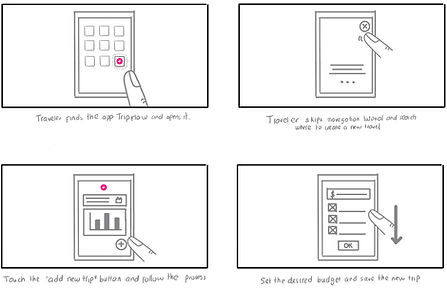
Storyboard

2. Define
The problem:
Existing travel-budget apps force users to choose between simplicity and functionality — interfaces are either too rigid to feel personal, or too sparse to provide real financial clarity. For emotionally-driven travelers, this creates friction at the exact moment they're trying to relax.
The goal:
Design a mobile app that gives travelers full control over their trip budget — through an intuitive trip-creation flow, real-time expense logging, and proactive alerts — without ever feeling like a finance tool. Success will be measured through budget-adherence metrics and traveler satisfaction.
Benchmark insights:
To validate the problem from the user's perspective, I conducted a competitive audit of two leading travel-finance apps — TravelSpend and Trabee Pocket — evaluated against three criteria: dashboard clarity, the trip-creation flow, and ease of expense tracking. Apps were selected based on review volume and quality within the travel-focused personal finance category.

The audit revealed a consistent pattern: most existing tools default to listing raw data rather than visualizing it, and gate core functionality behind paywalls — leaving users to decipher their own spending instead of understanding it at a glance. Most solutions suffer from poor visual hierarchy, confusing dashboards, and lack of emotional connection. Users want simplicity, speed, confidence, and delightful interactions.
Secondary research:
This research was complemented with secondary research across design platforms such as Dribbble, Behance, and Instagram to identify emerging patterns in finance dashboard design, including progress rings, category breakdowns, and trip-based balance summaries. Additionally, I conducted qualitative secondary research using online forums, industry articles, academic publications, and travel-related resources to better understand the needs, motivations, and pain points of BudgetPilot's target users, generating key insights that informed the product direction and feature ideation.


3. Ideate
User Flow:
-
Open the app
-
View Dashboard-Main Page window
-
Select the "Nuevo viaje" button
-
View New Trip window
-
Fill in Destination, Arrival Date, Return Date, Budget, and Currency
-
Is this information correct? (Yes or no)
-
View data save confirmation window

User Task: Use the BudgetPilot app to set the budget limit for a trip.
Sitemap:

Low-Fidelity Wireframes:

4. Prototype
High-Fidelity Wireframes:
I designed high-fidelity wireframes for the three core user flows that define BudgetPilot's primary functionality, as well as supporting screens for confirmation dialogs, alerts, and user feedback. To ensure consistency and scalability, I developed a reusable design system that streamlined the design process while maintaining a cohesive visual language and reinforcing BudgetPilot's brand identity.
Mockup
The interactive mockup was developed using Figma Make, leveraging AI-assisted prototyping to rapidly transform high-fidelity designs into a functional experience. By integrating AI into my workflow, I was able to accelerate iteration, validate interactions more efficiently, and dedicate more time to refining the user experience and product decisions.
5. Going forward
Conduct user testing using satisfaction-survey data gathered at the end of the user journey, to identify usage patterns and validate the most valuable features.
Introduce customization options that make the experience feel closer to each individual traveler.
Design a group-travel mode to manage shared and individual finances within the same trip.
Build a travel history feature with optional financial insights based on past spending habits.
Add optional biometric or numeric security for users who want greater privacy over their financial data.
.png)
